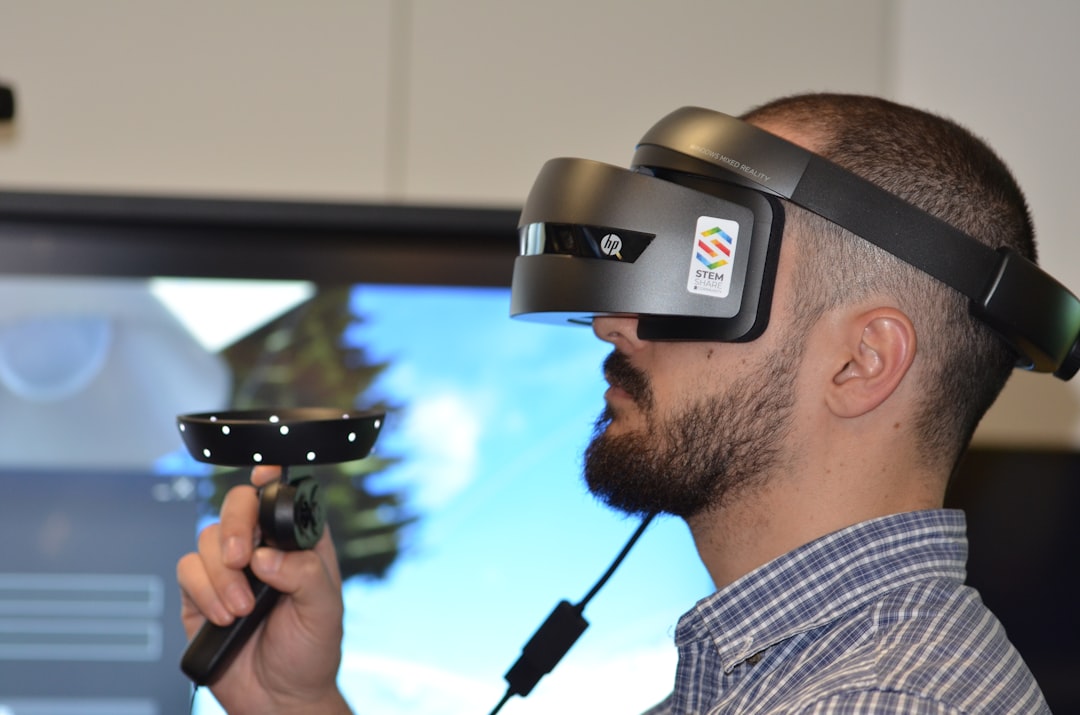
Virtual reality gaming stands at an inflection point in 2025. After years of gradual improvements and niche adoption, we're witnessing convergence of technologies that promise to bring VR into mainstream gaming consciousness. From revolutionary hardware eliminating long-standing comfort barriers to AI-powered systems creating dynamic worlds, the landscape of immersive gaming is transforming dramatically.
Next-Generation Hardware Redefining Possibilities
The hardware powering VR experiences has evolved significantly. Modern headsets launched in late 2024 and early 2025 showcase remarkable improvements across every dimension that matters to gamers. Resolution has reached levels where individual pixels become imperceptible, eliminating the screen-door effect that plagued earlier devices. The Meta Quest 3 and Apple Vision Pro demonstrate how far standalone processing has advanced, delivering graphics quality that previously required tethered connections to high-end gaming PCs.
Field of view expansion represents another critical advancement. New optical systems provide 120-degree horizontal FOV as standard, with premium devices pushing toward 150 degrees. This wider perspective dramatically enhances immersion by more closely matching human vision, reducing the tunnel-vision sensation that reminded users they were wearing headsets.
Weight distribution and comfort engineering have finally received the attention they deserve. Manufacturers now understand that even spectacular visual quality becomes irrelevant if users can't wear devices comfortably for extended gaming sessions. Pancake lenses and innovative counterbalance designs have produced headsets weighing under 400 grams while maintaining structural rigidity and premium build quality.
Eye Tracking and Foveated Rendering Maturity
Eye tracking technology has transitioned from experimental feature to essential component. Accurate gaze detection enables foveated rendering techniques that concentrate processing power on the specific area where the user is looking, rendering peripheral vision at lower detail levels. This optimization delivers massive performance improvements, allowing much more complex scenes and higher overall fidelity without requiring exponentially more powerful hardware.
Beyond performance benefits, eye tracking enables entirely new interaction paradigms. Menu navigation through gaze feels remarkably natural compared to controller-based selection. Social VR experiences gain unprecedented nuance when avatars accurately reproduce eye contact and subtle glances. Game designers are discovering creative applications, from stealth mechanics where enemies detect your gaze to puzzle games requiring specific looking patterns.
Hand Tracking Eliminating Controller Dependence
While controllers remain optimal for many game genres, hand tracking has matured to the point where controller-free VR gaming is genuinely viable. Computer vision algorithms now track individual finger positions with millimeter precision and minimal latency. This breakthrough enables interaction methods that feel remarkably intuitive—picking up virtual objects with natural grasping motions, manipulating interfaces through finger gestures, and expressing yourself through hand movements in social spaces.
Game designers are exploring mechanics specifically designed around hand tracking. Climbing systems let players reach up and grab holds naturally. Puzzle games incorporate intricate finger positioning requirements. Combat systems reward precise timing and positioning of blocks and strikes. These experiences simply weren't possible with binary button inputs, representing genuinely new gameplay territory rather than just alternative control schemes for existing genres.
Wireless Technology Removing Physical Constraints
Tethered VR imposed significant limitations on movement and game design. Players constantly maintained awareness of cable position to avoid tangling or tripping. Many compelling game concepts simply didn't work within these constraints. The widespread adoption of WiFi 6E and proprietary wireless transmission technologies has finally severed this tether for PC VR gaming.
Modern wireless solutions transmit uncompressed video at resolutions up to 4K per eye with imperceptible latency. Players freely move through their play spaces without cable management concerns. Game designers no longer need to account for restricted movement patterns, enabling 360-degree combat encounters, expansive exploration spaces, and physical gameplay that would have been impossible with cables.
Haptic Feedback Evolution
Visual and audio immersion have dominated VR development, but tactile feedback is emerging as the next frontier. Advanced haptic gloves provide genuine force feedback, allowing users to feel resistance when grasping virtual objects or contact when touching surfaces. These sensations dramatically enhance presence—the psychological state where your brain accepts the virtual environment as real.
Full-body haptic vests have progressed beyond simple rumble motors to directed feedback systems. Players feel the direction and intensity of impacts, environmental effects like rain or wind, and even subtle feedback communicating nearby activity. Combined with spatial audio, these tactile cues create remarkably convincing sensory environments.
AI-Powered Dynamic Content Generation
Artificial intelligence is transforming how VR game content is created and experienced. Procedural generation systems powered by machine learning produce varied, believable environments that feel hand-crafted rather than algorithmically assembled. NPC behavior has evolved beyond scripted responses to dynamic systems that adapt to player actions and generate contextually appropriate dialogue and reactions.
AI-assisted development tools are accelerating content creation. Developers describe desired assets or environments in natural language, and AI systems generate 3D models, textures, and even animation sequences. This democratization of content creation is enabling smaller studios to produce experiences with production values previously requiring massive teams and budgets.
Social VR and Multiplayer Evolution
Virtual reality's social dimension has matured substantially. Early social VR platforms felt like novelties—interesting experiments but not compelling enough to sustain engagement. Modern platforms incorporate lessons learned, providing activities that give people reasons to gather rather than just virtual spaces to occupy.
Multiplayer VR gaming has discovered its identity distinct from traditional online gaming. Proximity voice chat with spatial audio creates natural conversation dynamics. Shared physical challenges requiring coordination leverage VR's embodiment advantages. Asymmetric gameplay where VR and non-VR players interact opens new design possibilities and helps bridge the adoption gap.
Addressing Motion Sickness Through Better Design
Motion sickness remains VR's most significant barrier to mainstream adoption, but the industry has made remarkable progress understanding and mitigating this challenge. High refresh rates of 90Hz and above significantly reduce discomfort for most users. Developers have identified movement systems and camera behaviors that minimize nausea while maintaining engaging gameplay.
Comfort options have become standard, allowing players to customize their experience based on personal sensitivity. Teleportation movement eliminates artificial locomotion entirely. Vignetting reduces peripheral vision during movement. Snap turning replaces smooth rotation. These options ensure more people can enjoy VR gaming comfortably, expanding the potential audience dramatically.
Cross-Platform Play and Cloud VR Gaming
The VR ecosystem has historically been fragmented across incompatible platforms. Cross-platform play is finally becoming standard, allowing friends to play together regardless of which hardware they own. This compatibility reduces friction for new users worried about choosing the "wrong" platform and ensures healthier multiplayer populations.
Cloud gaming services are extending VR access beyond dedicated headsets. Users with capable devices can stream VR experiences without expensive local hardware. While latency remains challenging for fast-paced games, many VR experiences work remarkably well when streamed, potentially accelerating adoption by reducing the investment barrier.
The Path Forward
Virtual reality gaming in 2025 has overcome many obstacles that limited earlier adoption waves. Hardware is lighter, more capable, and more affordable. Software experiences are more polished and diverse. The ecosystem supports cross-platform play and social interaction. These advances are creating momentum that could finally push VR into mainstream gaming consciousness.
Challenges certainly remain. Content libraries need continued growth and diversity. Prices need to decrease further for mass-market penetration. Social perceptions of VR need to shift from novelty to legitimate gaming platform. But the technological foundations are now solid, and the industry is positioned to build something genuinely transformative.
For developers and gamers alike, 2025 represents an exciting moment. The medium has matured enough to support ambitious creative visions while remaining young enough that foundational design languages are still being established. The next generation of VR games will define what immersive gaming means for years to come. We're privileged to participate in this remarkable evolution of interactive entertainment.